Where Fort Wayne Previous Residents Appear by Era
A Fort Wayne address trail changes with the period under study. Modern parcel and Recorder systems are strong for ownership, while the ACPL Genealogy Center shelves, census schedules, maps, and newspaper files supply the household layer. No row below proves uninterrupted residence. Each is a dated observation that should be paired with at least one other record.
| Source | Years It Covers | Where Held | What It Shows |
|---|---|---|---|
| ACGSI deed index | Mainly 1824-1903 and 1913-1999 | ACGSI surname pages; verify at Allen County Recorder | Party role, year, and book/page or instrument citation |
| Recorder online data and images | Generally 1970-present; selected earlier material | Free Data Search, Tapestry EON, Laredo, or office counter | Recorded instruments, parties, recording data, and images |
| Fort Wayne city directories | 1858-present overall | ACPL Genealogy Center | Names, work, street text, and household marks by edition |
| Street cross-indexes | 1927-current, with 1972-98 noted by ACPL | ACPL reference holdings | Address-first routes to listed occupants |
| Federal census | Public schedules through 1950 | National Archives and library genealogy tools | Enumerated household, relationships, ages, and work |
| Sanborn and local maps | Fort Wayne sets include 1885, 1890, and 1902 | Library of Congress, State Library, and ACPL | Buildings, lots, addresses, uses, and block context |
For a recent address, begin with COMPS and the Recorder. For a twentieth-century household, begin with a street cross-index and then test the names against census, obituary, deed, and map evidence. Earlier searches often start with a name-indexed directory or intersection and work forward to a period map. The Fort Wayne city directory page explains the collections themselves; this page uses them to follow one parcel backward.
Start a Fort Wayne Previous Residents Trail with the Parcel
The present parcel is the fixed point for a search for previous residents. Open Allen County COMPS with the exact address. If it fails, the county guide suggests a shorter form, such as the street number and stem. Save the PIN, legal description, property address, owner field, transfer rows, neighborhood code, and access date. Open Property Information, Assessment Information, Owner Information, Voting Information, and Property Images separately because each tab exposes different fields.
The property card may show transfer dates, prior sale prices, township, lot dimensions, assessed values, deductions, building details, and an effective year built. That last field can change after remodeling, so it is not always the structure's first construction date. Owner information also is not an occupant list. It may name a person living elsewhere, a trust, a business, or several interest holders.
Key terms. A PIN identifies the tax parcel. A legal description describes the land independently of a changing street number. A chain of title is the linked series of recorded transfers affecting that land.
Fort Wayne Previous Residents in the Allen County Deed Chain
The Allen County Recorder records deeds, mortgages, releases, easements, plats, liens, and other instruments. Its free data search has no document images. Tapestry EON supplies a one-time paid route with documents generally from 1970 forward and name searching back to 1950, while Laredo resembles the office terminal. The free ACGSI deed index supplies the older bridge, mainly 1824-1903 and 1913-1999.
- Copy the present owner field, PIN, and legal description from COMPS.
- Find that owner's acquisition instrument and note both parties, date, and instrument or book/page citation.
- Search the seller as an earlier grantee, preserving middle initials, spacing, and business-name variants.
- Repeat the link backward, marking the declared ACGSI gap from 1904 through 1912.
- Confirm decisive links in the document image or request the deed at the Recorder counter, by phone, or through the stated copy route.
- Grantor and grantee
- The grantor transfers an interest; the grantee receives it. Neither role alone proves occupancy.
- Recorded instrument
- A filed deed or other document with its own date and citation, not a full biography of either party.
- Criss-cross directory
- An address-first directory that lets a reader browse a street and then see the listed name for a given edition.
The Fort Wayne Previous Residents Deed-Index Gap
ACGSI plainly identifies a 1904-1912 gap between its indexed runs. A missing surname row in those years therefore is not evidence that the parcel did not transfer. It means the online finding aid cannot answer the question by itself. Search Recorder images or office indexes, abstracts of title, plat books, newspapers, and archival files. The Recorder counter at 1 E Main Street, Room 100 is open Monday through Friday, 8:00 a.m. to 5:00 p.m.; staff can explain older book and index access.
Current Recorder information says address or PIN searches may not reach before 1995. Name searching is therefore essential for an older chain. ACGSI also preserves spacing differences such as a surname written with and without an internal space. Search both forms and retain the exact spelling in notes. This gap-aware method is slower, but it prevents a portal cutoff from becoming a false conclusion about past residents.
Renumbered Homes and Fort Wayne Previous Residents
A Fort Wayne house can appear under two numbers even when the building did not move. The ACGSI street-history page cites the late-1890s renumbering effort and gives a sharp example: John Sollberger's saloon appeared as 232 W Main in 1900/01 and 916 W Main in 1902. Street names also changed, including Water to Superior and Erie to E Berry. A modern address-only search can miss both forms.
Copy the old directory text exactly, including intersections. Then compare a same-period State Library map or a Library of Congress Sanborn sheet. Move to modern GIS only after the block and parcel geometry line up. Calhoun Street and the St. Mary's and Maumee Rivers are the reference lines in the current numbering code, which can help orient an old north, south, east, or west address.
Sanborn maps show footprints, use labels, addresses, and nearby structures. Historical COMPS aerials cover 1938 through 2021. Neither source names every person in a house, but each can show whether the building, lot, or street configuration changed between two resident observations.
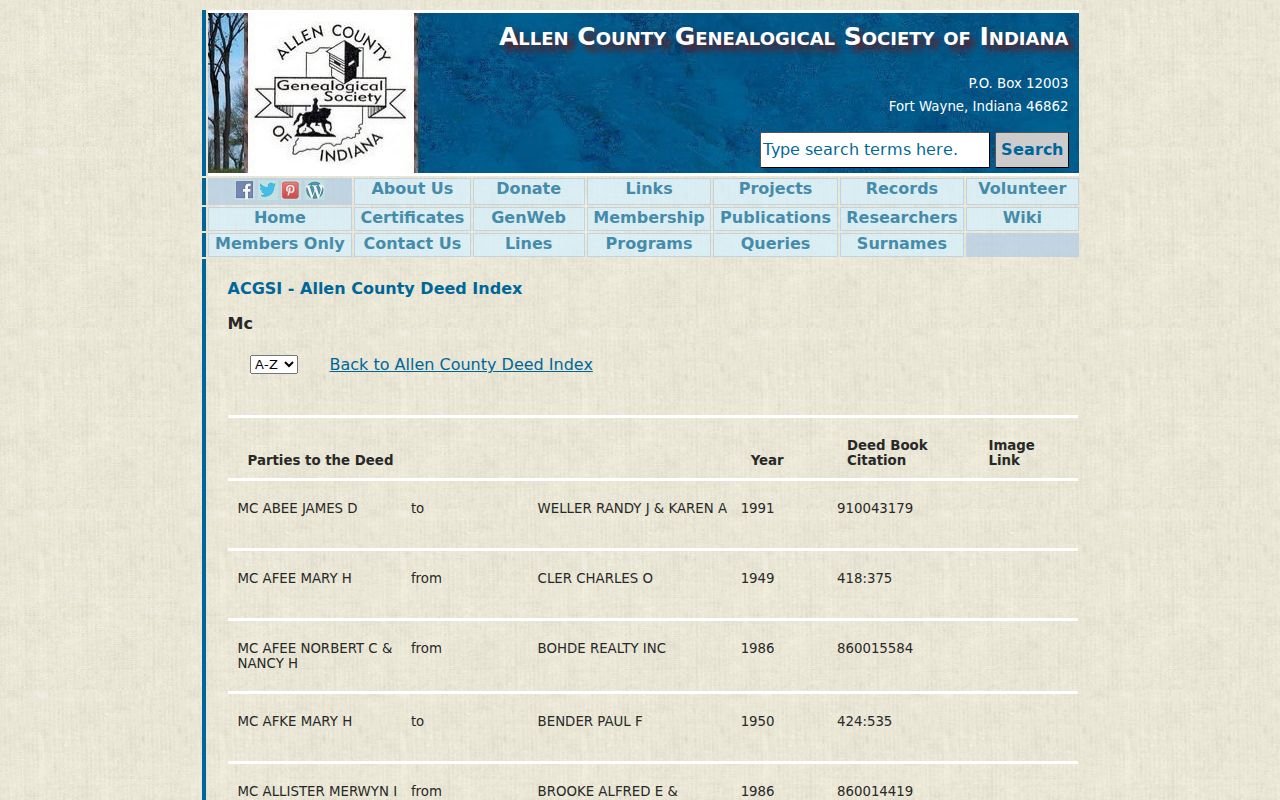
The ACGSI sample deed index shows the role-and-citation format used to bridge an address trail.
Pair Fort Wayne Previous Residents with Census Clues
Ownership is only half of a previous residents search. ACPL holds Fort Wayne directories from 1858 to the present, including street cross-indexing for much of the later run. A dated listing can connect a printed name to an address, occupation, spouse marker, or business role, depending on the edition. It is stronger evidence of a listed household than a deed, but still reflects one publication and may omit boarders, short-term occupants, or an entire street.
- Record the directory title, year, page, name, address text, and any household mark exactly.
- Compare the prior and next available edition, treating an appearance or disappearance only as a lead.
- Pair the nearest public federal census schedule, released under the 72-year rule, with the period map and directory.
- Check ACGSI obituary indexes, ACPL newspapers, probate, cemetery, or vital indexes for a dated event or relationship.
- Write a limited conclusion, such as "listed at this address in the 1902 directory," instead of claiming continuous residence.
Allen County vital coverage also changes by geography. County genealogy material starts births in 1882 inside Fort Wayne but 1887 outside the city, and deaths in 1871 inside the city but 1907 outside. For early events, ACPL microfiche, newspapers, churches, cemeteries, and local Health records may be more useful than a state portal. Access and certification rules still apply.
Lawful use. Fort Wayne house history supports genealogy and personal research. Never use a historical trail to track, harass, or expose a living person.
ACPL Sources for Fort Wayne Previous Residents
The ACPL Genealogy Center house-history guide points beyond deeds and directories. Its route includes Builders of Greater Fort Wayne, Fort Wayne Architects & Firms, family histories, cemetery files, maps, photographs, newspapers, vertical files, Community Album material, historic preservation records, and help from the History Center. These sources can explain a building and neighborhood even when they do not identify an occupant.
ACPL's Genealogy Center is at 900 Library Plaza and can be reached at 260-421-1225. The Fort Wayne History Center at 302 E Berry Street holds local photographs, documents, and artifacts. Online digital collections provide a first look, while staff contact or an in-person visit is the fallback when a catalog record has no scan. Keep a worksheet with the address form, PIN, source year, role shown, repository, page or instrument number, and access date.
The History Center digital collections offer visual and documentary context for a Fort Wayne property.