
Fort Wayne Directory Collections
The Fort Wayne city directory shelf is unusually deep. ACPL holds originals or photocopies of almost every issue from 1858 to the present, while the Indiana State Library preserves named printed and microform runs. Public-domain issues before 1923 have been digitized selectively. Start with the broad ACPL run, then use the State Library or a scan when a local volume, year, or format is unavailable.
| Collection | Years | Where Held | Access |
|---|---|---|---|
| Williams Fort Wayne Directory | 1858-59; 1860-61 sample | Internet Archive and ACPL transcription | Free scan and finding aid |
| ACPL local directory run | 1858-1998; 1999-present | ACPL Genealogy Center | On-site volumes and staff help |
| Indiana State Library microform | 1861-81; 1902-35 | Indiana State Library | On-site reference access |
| Polk Fort Wayne directories | 1926, 1928, 1930-32 | Indiana State Library; related ACPL run | Reference copies |
| Street cross-indexed directories | 1927-current; 1972-98 noted | ACPL Genealogy Center | Address-first search |
| Telephone directories | Selected issues, 1920-2025 | ACGSI-listed local collections | Issue-specific evidence |
The research does not establish one final printed directory year distinct from telephone runs. Record the exact title, publisher, edition, page, shelf mark, and format. A missing issue or absent name is not proof of a move.
ACPL's Fort Wayne Directory Shelf
The ACPL Genealogy Center is the main in-person route. Its house-history handout gives two shelf marks: 977.202 F77p for 1858 through 1998 and 977.201 AL5acd for 1999 to the present. The center is at 900 Library Plaza and can be reached at 260-421-1225 or genealogy@acpl.info. Staff can help locate an edition, street cross-index, map, obituary index, newspaper reel, or house-history file.
Layout varies by year. Some books begin with names, and later books may add an address-first section. Rural-route codes and county material need separate attention, including 1906 and 1965-68 references noted in the ACPL handout. Ask what is bound with the target edition before assuming every volume has the same index.
Fort Wayne's 1858 Directory Online
The 1858-59 Williams Fort Wayne Directory is the earliest located local volume. It is openly digitized at Internet Archive, while ACPL provides a transcription of selected 1858-61 entries. The scan preserves the printed page. The transcription makes several names easy to find. Compare both before normalizing spelling or an address.
Open the digitized Williams Fort Wayne Directory to inspect the edition itself.
The scan supports a page-level citation and shows how much layout and context a plain transcription can omit.
Read Fort Wayne Directory Entries
An early Fort Wayne city directory entry may give a full name, initial, work description, side of street, cross streets, or numeric address. The ACPL sample lists Willis Elliott as a barber on the north side of Main between Clinton and Calhoun. Saml. Ward appears at 44 W Wayne in 1858-59. Preserve the printed form, including initials and abbreviations.
| Printed name | Exact spelling, initials, title, and alphabetic position |
|---|---|
| Work or role | Occupation or business wording used in that edition |
| Place | Street side and cross streets, number, or rural-route code |
| Household marks | Spouse, widow, boarder, or roomer notation when supplied |
| Entry type | Home, business, organization, or telephone listing |
- Criss-cross directory
- An address-first listing arranged by street and house number rather than surname.
- Householder index
- A section grouping the named person responsible for a listed household under that publisher's rules.
- Abbreviation key
- The edition's guide to short forms for residence, spouse, widow, and other marks.
Do not borrow a symbol's meaning from another edition. Photograph or note the key from the same volume. An omitted work line proves nothing by itself.
Fort Wayne Directory Address Shifts
Fort Wayne's house renumbering can make one building appear to move. ACGSI reports a proposed 1898 ordinance and shows John Sollberger's saloon at 232 W Main in 1900/01, then 916 W Main in 1902. Street names changed too. An entry from before that transition should be paired with a period map, intersection, nearby business, or property description.
Modernizing an old number too soon can create a false match. Library of Congress Sanborn maps from 1885, 1890, and 1902, the 1913 guide map, and Indiana State Library street plans can bridge the old entry to later parcel geometry.
Fort Wayne Directory Milestones
The collection developed across print, microform, street indexes, and digital access. These dates mark known holdings and search changes, not a complete annual schedule.
| 1858-59 | The digitized Williams directory begins the located local run. |
|---|---|
| 1860-61 | ACPL sample entries include numeric addresses and work descriptions. |
| 1861-81 | Indiana State Library preserves a microform run. |
| 1898-1902 | House renumbering creates a major address crosswalk issue. |
| 1927-present | ACPL research notes a street cross-index practice. |
| 1999-present | ACPL catalogs the later run under a separate shelf mark. |
Telephone books, association directories, and county-wide titles overlap the timeline. Cite each by its exact issue and scope.
Beyond Fort Wayne City Directories
Nearby sources can test the same name or address when a directory year is absent. ACGSI lists selected telephone directories from 1920 through 2025, obituary indexes, rural and town directories, and neighborhood volumes. ACPL digital collections include photographs, Williams-Woodland Park material, and the Fort Wayne Black Pages and Professional Directory. The History Center holds more than 32,000 artifacts, photographs, and documents.
These sources have narrow meanings. Neighborhood books are not citywide rolls. A telephone book reflects its own subscribers. The Black Pages can add business and professional context, but a business address does not prove where every listed person lived.
City Records Confirm Fort Wayne Events
A directory gives a dated listing, while a city record may document a dated event at the same place. City Clerk agendas and minutes can contain street changes, petitions, appointments, and public projects. Accela and code files can identify permit or case activity. Use those sources to test an event, not to turn an old entry into a claim of continuous occupancy.
The Fort Wayne City Clerk is a gateway for many municipal records.
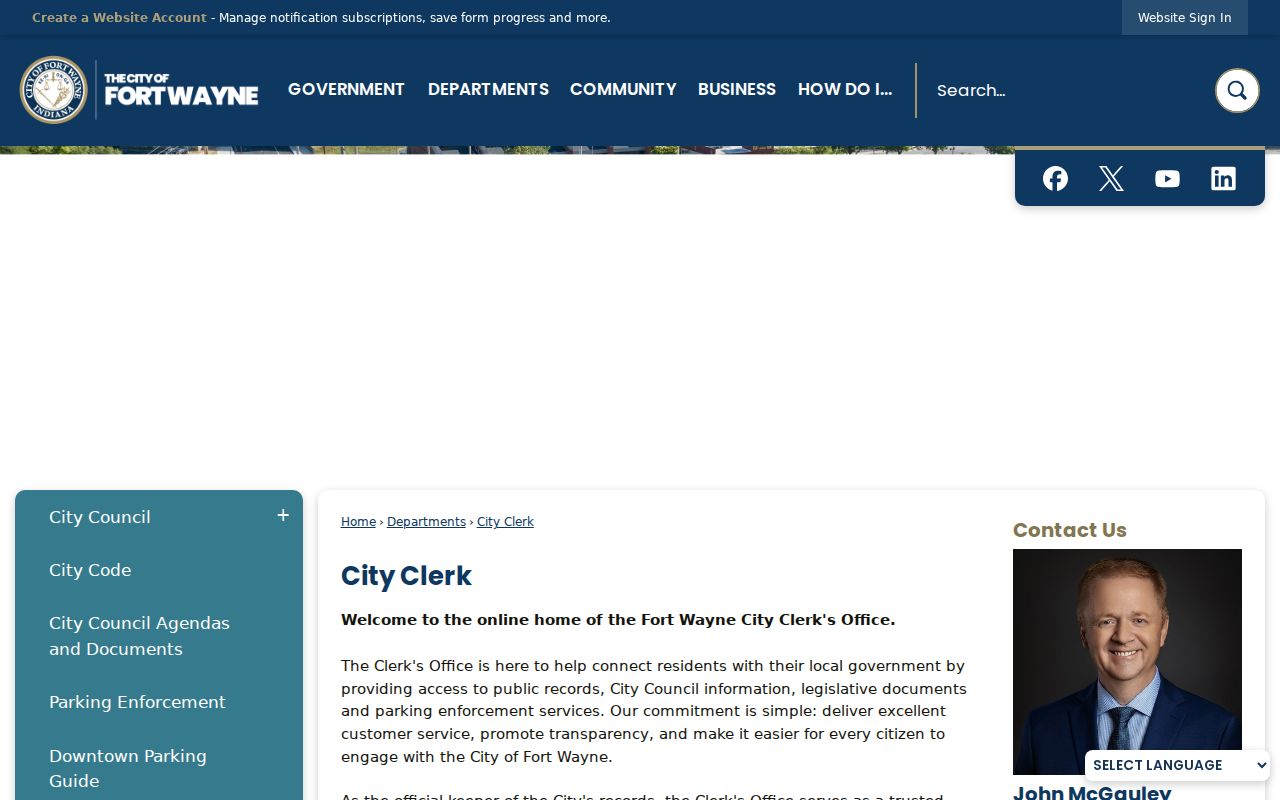
The Clerk route is most useful when a directory clue points to a named civic act, meeting, project, or street change.
Trace Family in Fort Wayne Directories
A sound family-history trail uses successive observations. Copy the entry, then test it against a map and the next available edition. A changed address, widow mark, business-only listing, or disappearance suggests a new question. Federal census releases can fill decade snapshots. Deeds, obituaries, vital indexes, cemetery records, and newspapers can explain a household change.
- Cite the title, edition, page, holder, and access date. Copy the name and address exactly.
- Test the street text against a same-period map and the 1898-1902 renumbering evidence.
- Check the next available volume for the same name, initials, spouse marker, address, or firm.
- Pair dated entries with a released federal census and a deed, vital index, or newspaper item.
- Use an obituary or cemetery record as another dated source, then reconcile conflicts.
A person may disappear because of a move, death, changed name, skipped canvass, unlisted telephone, or publication gap. Search initials, spouse names, and old spellings. For modern property ownership, the Fort Wayne street directory workflow moves from an address to COMPS and recorded deeds.
Access Fort Wayne Directory Sources
Not every Fort Wayne city directory is open on the web. Begin with the public Internet Archive scan when its year fits. For the fuller run, visit or contact ACPL's Genealogy Center. Give staff the year, spelling, address, and source already checked. The Indiana State Library's Allen County holdings guide is the next route for Polk editions, Fort Wayne and Allen County titles, and microform. The History Center at 302 E Berry Street can help with collection-specific local photographs and documents.
FamilySearch adds an archival film layer for some Allen County records, but access varies by catalog item, contract, account, FamilySearch Center, or affiliate library. Its marriage images are marked unofficial and serve genealogy, not certified proof. When an online catalog exposes only a title or film number, take that citation to the holding library rather than promising an unrestricted image.
- Use the online scan for page images from a digitized edition.
- Ask ACPL for shelf volumes, microfilm, maps, house files, and obituary help.
- Check the Indiana State Library for specific printed and microform runs.
- Contact the History Center for photographs, artifacts, and collection guidance.
- Request official certified records from the actual county or state custodian.
A directory entry itself is not a certified public record. For a legal copy of a deed, court record, marriage, birth, or death record, follow that custodian's eligibility and copy rules.